
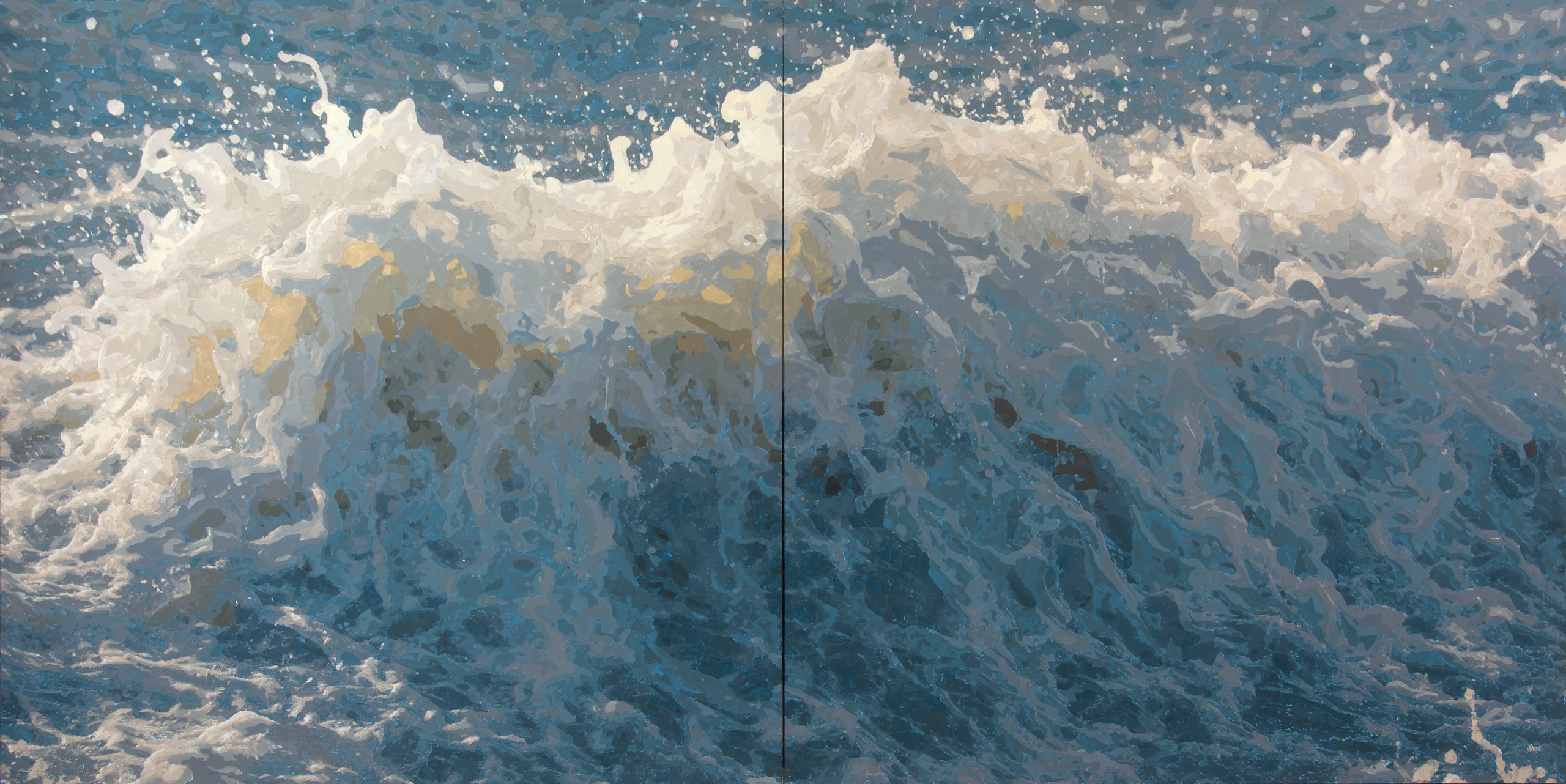
For years the work of this studio has been built around cities: streets, facades, bridges, the geometry of places where people live and move. Sampled Realism grew up on that kind of subject. A building has edges, a window has a frame, a street has a vanishing point. The sea has none of these. That is exactly why the series of ocean wave paintings matters here: it takes a method shaped by architecture and applies it to water, foam and light — at every scale, from a 50×70 cm canvas to a 240×120 cm diptych.
Why the sea, after the city
Marco Barberio is an Italian contemporary urban artist, and his Sampled Realism has always been inspired by architecture, time, urban landscapes and seascapes. The sea was already part of the vocabulary. What changed was a single photograph.
The series began with a picture taken in Capri. It was an image that particularly inspired him, and he tried to render it through Sampled Realism, the same way he would treat a street corner in New York or a square in an Italian town. The effect struck him, and the series grew from there, built on photographs taken along the coasts of Calabria and the Amalfi Coast.
The path that leads here is not academic. Marco is a self-taught painter. In the 1980s he painted graffiti on city walls, in the 1990s he specialised in airbrush painting, and later he worked in graphic design as an art director, designer and developer.
The method does not change
The most surprising thing about the sea series is that nothing in the process had to be reinvented. The same steps used for the urban paintings are applied, unchanged, to waves and water.
- A photograph of his own. Every painting starts from a photograph Marco takes himself.
- Colour reduced by software he wrote. The photograph is processed with his own software, which reduces and adjusts the colours. Elements of the scene can be removed or added, and the light can be changed.
- Stencils designed and laser-cut. The stencils are designed with the same software, which keeps enclosed “islands” intact without stencil bridges, and are cut by laser. Earlier he cut them by hand, then with a computer-controlled cutter he built himself.
- Painted by hand, one colour area at a time. Most of his paintings are made entirely in acrylic, mainly on canvas. Each colour area is painted by hand, one after another.
- Six to ten days. A painting usually takes between six and ten days.
What a city gives the method for free — straight lines, clear borders between light and shadow — a wave does not. Yet once the colours are reduced, the sea turns out to be made of distinct areas too: the dark body of the water, the bright edge of the crest, the white of the foam broken into many small shapes. Sampled Realism does not blur these into a soft gradient. It keeps them separate, and the eye puts the movement back together.
The large waves: canvases and diptychs
The method shows its character most clearly at large scale. On a big canvas each fold of foam becomes a colour area of its own, and the wave is no longer a view of the sea but something close to the viewer.
Aqua and Aqua #2
Aqua, 192×134 cm, 2024, catches the crest of a wave in low, warm light: ivory and soft peach on the lit side, blue-grey and deep shadow on the other. Aqua #2, same size, 2025, turns the light cooler: a column of white foam rises out of deep blue water and folds back on itself. Both paintings have been sold.
Onda and Wave: two diptychs
Onda — Italian for wave — and Wave are diptychs, each 200×120 cm overall. Onda, from 2026, is the darkest of the large paintings: cream and ivory foam surging across a slate-blue sea. Wave, from 2025, is built around a single column of foam rising straight up from a choppy grey-blue surface. In both, the wave runs across the join between the two panels. Both have been sold.
Wave of Light
Wave of Light, 2026, is the widest painting of the series: a diptych of 240×120 cm. The crest of the wave is seen against the light, white foam with warm golden tones glowing through it, over a bright blue sea scattered with spray. It is the large sea painting currently available.
Smaller waves
The smaller canvases look at the same moment — the water rising, holding a shape, already about to fall apart — in formats that fit more easily into a home.
Wave #4, a square canvas of 80×80 cm painted in 2026, shows a surge of water that reads almost as a solid form before it dissolves back into the ocean. wave #5, 50×70 cm, 2026, opens the foam out of deep blue water and is as much about light and texture as about the wave itself. Wave #3, 50×70 cm, 2026, brings the viewer close enough that the wave becomes a dense, almost tactile mass of foam. Little wave, 60×60 cm, 2025, is the quietest of the group: a small fragment of the sea, caught while it rises and dissolves at the same time.
Still water: stones, reflections and the Italian coast
The sea is not only movement. Another side of the series looks at water when it is calm, and at what it shows rather than what it does.
Water Stones #2, 60×80 cm, 2024, looks down through shallow coastal water at smooth stones beneath the surface. Here the challenge for Sampled Realism is transparency: the stones, the water above them and the reflections of light on the surface all have to be described with flat colour areas, without losing the sense that one is seen through the other.
Reflections of Procida, 100×100 cm, 2025, moves from open water to the Italian coast as people live it. The colourful waterfront of the island of Procida is mirrored in a calm sea, and the painting is split between the architecture above and its broken reflection below. It is the point where the sea series and the urban work meet.
Choosing a sea painting for your living room
A sea painting changes a room in a different way from a city scene. A few practical points help when choosing one.
- A large statement piece. Wave of Light, at 240×120 cm across two panels, is meant for a wall that can hold it on its own, such as a living room or an open space.
- Medium and square formats. Wave #4 at 80×80 cm, Little wave at 60×60 cm and Water Stones #2 at 60×80 cm are easier to place above a sideboard or a sofa. The 50×70 cm canvases, Wave #3 and wave #5, can also hang as a pair.
- Energy or calm. A breaking wave brings energy into a room; still water and reflections bring calm. In a light, quiet interior, Water Stones #2 or Little wave keep the atmosphere soft.
- A smaller budget. For Wave #3 there is a limited edition giclée print, made from the original painting.
Frequently asked questions
Are these wave paintings original works on canvas?
Yes. The paintings in the series are acrylic on canvas, painted by hand one colour area at a time.
How is a Sampled Realism sea painting made?
It starts from a photograph Marco takes himself, taken on the coasts of Calabria or the Amalfi Coast. The colours are reduced with software he wrote, the stencils are designed with the same software and cut by laser, and the painting is built by hand over six to ten days. The process is the same one used for his city paintings.
Is there a print of the wave paintings?
Yes, a limited edition giclée print of Wave #3 is available.
What sizes are the sea paintings?
The works in this series range from 50×70 cm canvases to the 240×120 cm diptych Wave of Light.