
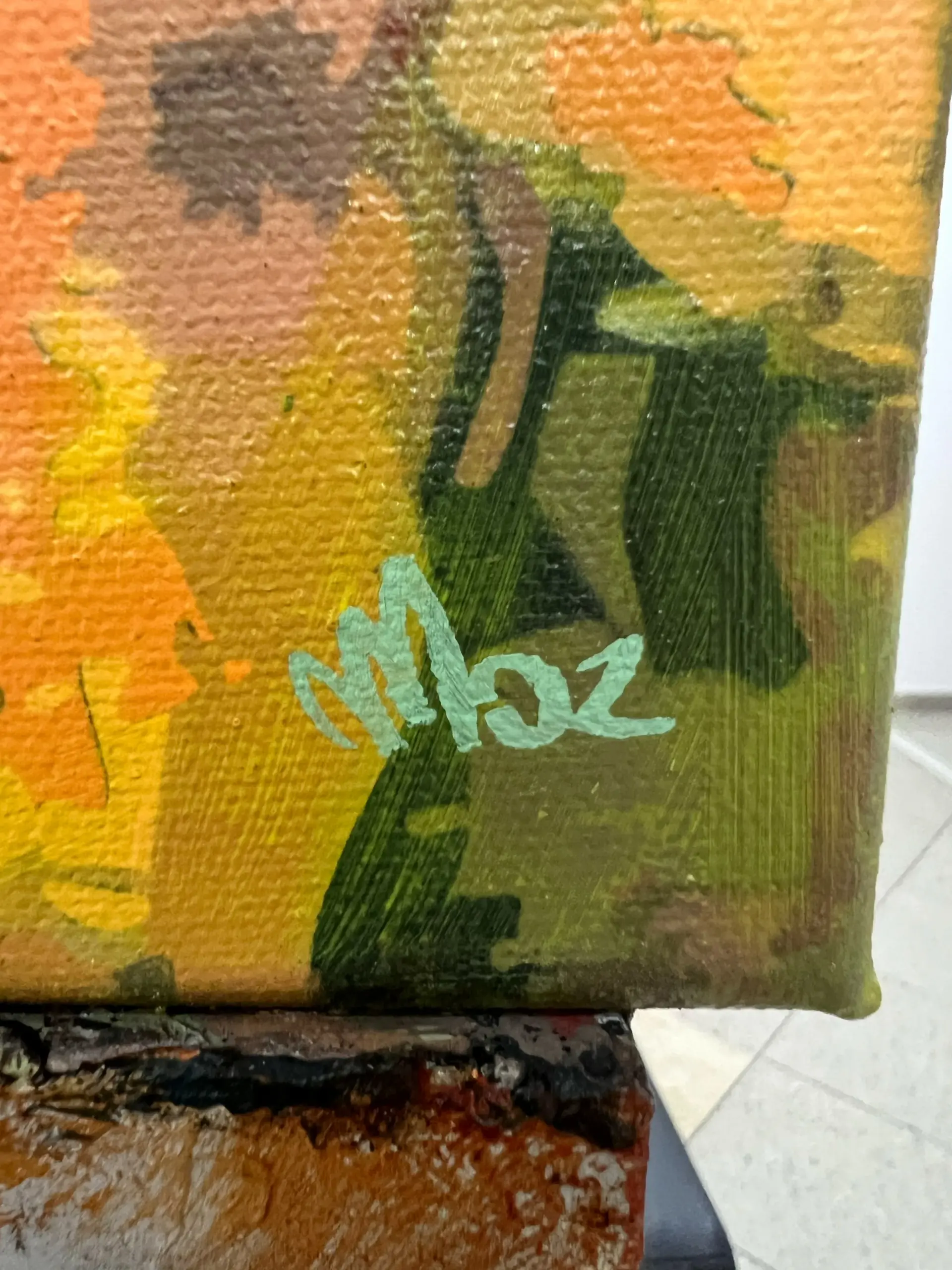
Seen up close, a Sampled Realism painting raises an obvious question: is it painted, or printed? The answer is that it is painted, by hand, shape by shape. But before the first colour reaches the canvas there is a long stretch of work at the computer, and that part is easy to misunderstand. This article follows one painting, Lombard Street Sunset, from the photograph to the finished canvas.
It starts with a photograph
Every painting starts from a photograph Marco Barberio takes himself, with a clear idea of the picture he wants. The subjects are places he has been: streets, buildings, the sea. For Lombard Street Sunset the starting point was the view down the curves of Lombard Street towards the bay, with a cable car crossing the foreground in the last light of the day.
The photograph is not the painting. It is the material the painting is built from.
Reducing the colours: the sampling
The photograph is processed with software Marco has written himself. Its first job is to reduce the colours: the many tones of the photograph become a limited number of flat areas, each with a clear edge. This is the “sampling” that gives Sampled Realism its name. Up close the painting is made of separate patches of colour; from a distance they read as a realistic scene.
This stage is also where the image is composed. Some colours are shifted towards tones that, to his eye, work better together. Elements of the scene can be removed or added, and the overall light can change, from morning to sunset for example.
Designing and cutting the stencils
To carry every shape faithfully onto the canvas, the image is turned into stencils. These are designed on the computer too, with another program of his own.
Anyone who has cut a stencil knows the problem of “islands”. Think of the letter O: if you cut out the ring, the centre falls away. The usual fix is a “bridge”, a thin strip that holds the centre in place but leaves a gap in the painted shape. Marco’s software plans the cuts so that islands are kept without those bridges, so the shapes on the canvas stay whole.
The cutting itself has changed over the years. He first cut the stencils by hand, then with a computer-controlled cutter he built himself. Today they are cut by laser.
Painting: acrylic or spray
With the stencils ready, the painting begins. Most paintings are made entirely in acrylic; some are made entirely in spray paint, depending on the effect he wants. Lombard Street Sunset and San Francisco Sun are acrylic on canvas. Radio City, a Manhattan scene at dusk, is painted in spray.
Spray paint comes in a fixed range of colours, so it cannot be mixed the way acrylic can. For spray works, a further program of his own finds the available spray colours closest to the ones the image calls for.
Canvas, paper and time
Canvas is the surface Marco prefers. Smaller works, more accessible in size and price, are made on paper.
A painting usually takes between six and ten days.
Where the method comes from
The method has a long history behind it. In the 1980s Marco painted graffiti on city walls; in the 1990s he specialised in airbrush painting. He later worked in graphic design, as an art director and as a designer and developer. He is self-taught, and his studio is in Lamezia Terme, Italy.
Each of those steps is visible in the process: spray paint and stencils, precise control of colour, and software written in the studio rather than bought.
What this means for a collector
The computer prepares the image and the stencils. The painting itself is done by hand, in acrylic or spray, one colour area at a time, over a week or more. What you buy is a single painted canvas, not a print of a digital file.
If a painting you like is also offered as a limited edition giclee print, that print is a reproduction of the original painting, and it is described as such on its page.
Frequently asked questions
Are the paintings printed or digital?
No. Software is used to prepare the image and to design the stencils. The painting is done in acrylic or spray paint on canvas.
Why use stencils instead of painting freehand?
To carry every shape from the prepared image onto the canvas faithfully.
How long does one painting take?
Usually between six and ten days.
Acrylic or spray paint?
Most works are made entirely in acrylic, some entirely in spray paint, depending on the effect the painting needs.