
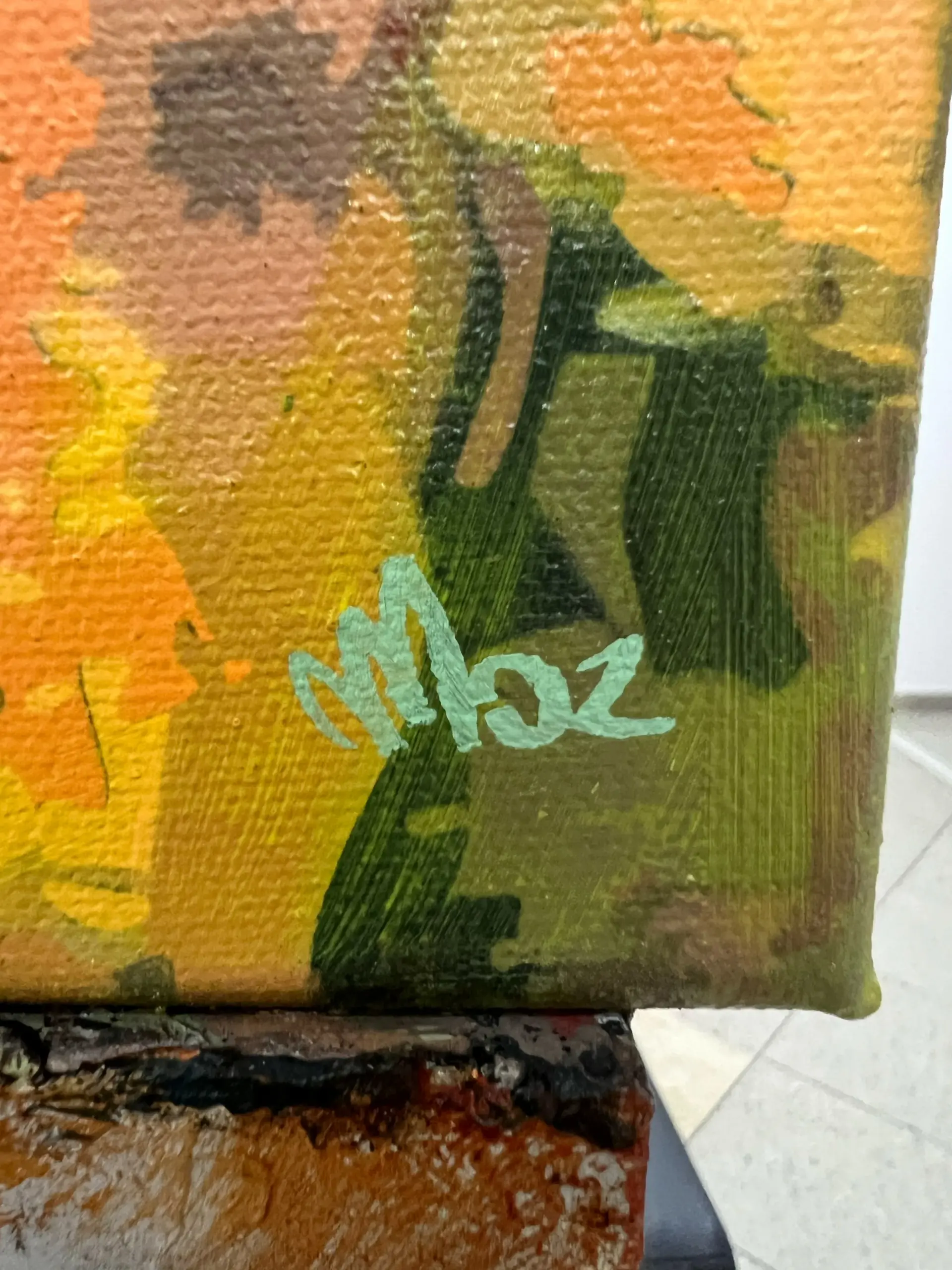
Sampled Realism is the way of painting formulated by Marco Barberio in 2015. Cities, streets and everyday places are translated into paint through a “sampling” of colour: instead of blending, each colour becomes a flat area with a sharp edge, and the image is built from these areas like layers. Seen as a whole, the painting looks realistic. Seen up close, it shows what has been left out.
What Sampled Realism means
Sampled Realism is an attempt to translate an abstract idea, a state of mind drawn from the real world and from everyday life, into a painted image, looking for a balance between science and art.
Urban landscapes, architecture, streets and places are a pretext to stop a single instant. In these painted “shots” the city is not scenery: it is a moment of suspension, the opening frame of a story whose action seems to happen off-screen. Time is frozen, and space becomes an active part of the narrative.
Why “sampled”: an idea borrowed from digital sound
The term comes from music. A sound played live is a continuous signal. When it is recorded digitally, it is sampled: its values are stored at a fixed frequency, and the continuous analogue signal becomes a sequence of discrete points. Some information is lost between one sample and the next, yet we hear the result as if it were the original.
In the digital age, much of the reality we live is sampled in the same way, captured and stored in electronic devices. Sampled Realism applies this process to painting.
Colour as level curves
In a Sampled Realism painting colours are not mixed. They become patches and curves with no shading between them, much like the contour lines of a topographic map, or the layered slices of a tomography scan that together render a three-dimensional body.
The jump between one colour area and the next, sometimes subtle, sometimes sharp, hides an omission. Those gaps are deliberate.
What is left out
The omissions are a metaphor for modern digital life: every day we lose pieces we consider unimportant, and at a distracted glance the loss goes unnoticed. That is the meaning of the name. From a distance the paintings seem to pursue realism; a closer look reveals the missing information, marked by the sharp contrast between one area of colour and another.
These gaps stand for what our lives leave behind, and at the same time they leave room for the viewer to rebuild the scene from their own knowledge and experience.
Sampled Realism and hyperrealism
Hyperrealism is defined by an obsessive accumulation of detail. Sampled Realism takes the opposite direction: it deliberately leaves details out and sets out to lose information. The realism is in the overall image, not in the single detail.
How the paintings are made
From a photograph to a sampled image
Every painting starts from a photograph Marco takes himself, with a clear idea in mind. The image is then processed on the computer with software he has written: the colours are reduced to a limited number of flat areas, and some are shifted towards tones that, to his eye, “sound better”. The scene itself can change: elements are removed or added, and the overall light can move from morning to sunset.
Stencils cut by laser
To carry every shape faithfully onto the canvas, the image is turned into stencils. These are also designed on the computer, with another program of his own that plans the cuts so that “islands”, the enclosed shapes that would otherwise fall out of a stencil, are kept without the awkward “bridges” stencils usually depend on. He first cut the stencils by hand, then with a home-built, computer-controlled cutter; today they are cut by laser.
Acrylic or spray
Most paintings are made entirely in acrylic; others entirely in spray paint, depending on the effect he wants to achieve. For spray works, a further program of his own finds the spray colours closest to the colours the image calls for.
Canvas and paper
Canvas is the surface he prefers. Smaller, more accessible works are made on paper.
Time
A painting usually takes between six and ten days.
Background
In the 1980s Marco painted graffiti on city walls, while also working in acrylic. In the 1990s he specialised in airbrush painting. He later worked in graphic design, as an art director on many major projects and as a designer and developer himself. He is self-taught, and his studio is in Lamezia Terme, Italy.
Recognition
Marco Barberio’s work has received the Finalist Award at the Art Olympia International Open Art Competition 2017 in Tokyo, the Marchionni Prize 2019, and an honourable mention as a finalist in the Stencil Art Prize 2019 in Sydney. The full list is on the Awards & Grants page.
Frequently asked questions
Who created Sampled Realism?
Sampled Realism was formulated by the Italian painter Marco Barberio, who published its statement on September 24, 2015.
Is Sampled Realism the same as photorealism or hyperrealism?
No. Photorealism and hyperrealism aim to reproduce every detail. Sampled Realism simplifies colour into flat, separate areas and deliberately removes information: the image reads as realistic from a distance and reveals its gaps up close.
Why is it called “sampled”?
Because it follows the logic of digital sampling in music: a continuous reality is stored as discrete pieces, losing something between one piece and the next, yet it is still perceived as whole.
What materials are used?
Most paintings are made in acrylic on canvas; some are made in spray paint. Smaller works are made on paper.
Are the paintings printed or digital?
No. The computer is used to prepare the image and to design the stencils, which are cut by laser. The painting itself is done in acrylic or spray paint, shape by shape, on the canvas.
How long does a painting take?
Usually between six and ten days.
Where can I see the paintings?
Available works are listed in Available Paintings.